2026-10-06
3 Common Oversights Before Starting Tattoo Removal in Bangbae
Clears up three common myths about Bangbae tattoo removal: why stronger lasers don't work faster, why faded ink isn't easier to remove, and how ink color affects treatment.



When we consult with people in Bangbae who are looking into tattoo removal, we often hear similar questions, such as “How many laser sessions will it take to fully remove it?” or “My tattoo is old and the color has faded. Can it still be removed?” Most people searching for Bangbae tattoo removal seem to have very similar concerns. Today, we’ll go through some common misconceptions one by one and outline the information that is genuinely helpful to know when considering tattoo removal in Bangbae.
Myth 1: Simply firing the laser at higher intensity will make a tattoo disappear faster.
That’s not actually the case. Tattoo pigment sits in the dermis, not the epidermis, and the dermis is a tissue that regenerates slowly, so the ink does not fade on its own. Raising the laser intensity excessively does not break down the pigment any faster. On the contrary, pushing beyond what the skin can tolerate can lead to side effects such as redness, pigmentation, and, in rare cases, scarring. This is why Bangbae tattoo removal is safer when it is carried out gradually, in stages with set intervals.
Myth 2: Faded tattoos are easier to remove.
Even if a tattoo has faded over time, the pigment itself has not disappeared. In many cases it has spread widely throughout the skin. On the other hand, if the pigment particles are scattered unevenly, the laser response can also be uneven. When considering Bangbae tattoo removal, how the ink is distributed within the skin matters more than how the color looks on the surface.
Myth 3: All color tattoos are difficult to remove.
Color | Laser Response Characteristics |
Black tones | Absorbs light well, so it tends to respond relatively well |
Red and orange tones | Responds well to certain wavelengths |
Blue and green tones | Absorbs a limited range of wavelengths, so it tends to take longer |
Yellow tones | Tends to respond relatively slowly |
Because each color responds at a different speed, multicolor tattoos and cover-up tattoos often require more sessions than single-color tattoos. Cover-up tattoos are especially tricky: new ink is layered over an existing tattoo, so the total pigment load is higher and the layers overlap. This means the difficulty is often hard to judge based only on the colors you can see on the surface.

Why treatment intervals matter
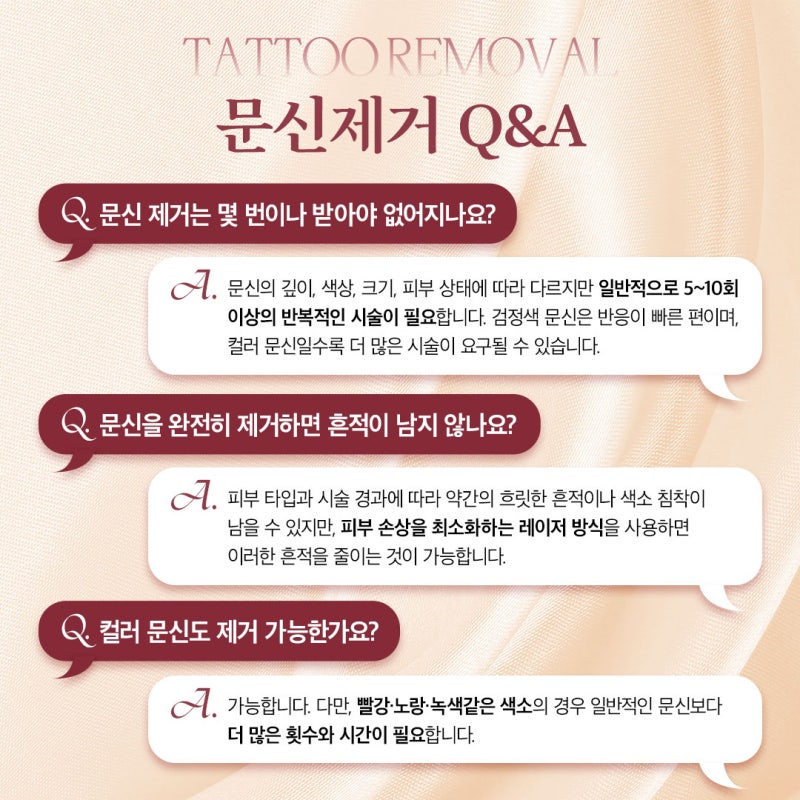
Tattoo removal rarely finishes in a single session. The particles that the laser breaks into fragments are gradually eliminated through the body’s metabolic processes, and this takes a certain amount of time. If repeated stimulation is applied without sufficient intervals, the skin may not have enough time to recover, which can increase the risk of side effects such as inflammation or pigmentation. So when planning Bangbae tattoo removal, the key is not how many sessions it will take to finish, but how the intervals are adjusted while monitoring the condition of your skin.
Points to check before choosing a treatment
The color composition of the tattoo (single color or multiple colors mixed)
When the tattoo was made and the degree of pigment deposition
Whether it is a cover-up, and how much ink has been layered over the original tattoo
Your skin type and any past experience with pigmentation or scarring
How well you can manage sun exposure after treatment
Because these factors vary greatly from person to person, a plan should be made after your skin condition is examined in person during a consultation. After treatment, temporary swelling, scabs, and pigmentation may appear, and recovery speed varies from person to person, so it’s good to keep these in mind. In particular, forcibly peeling off a scab can lead to scarring or discoloration, so letting it fall off naturally is best for recovery.
Frequently Asked Questions about Bangbae Tattoo Removal
Q. How many sessions does tattoo removal usually take?
A. It varies greatly depending on the tattoo’s color, amount of ink, and depth, so it is difficult to give a single answer. A rough plan can be put together through a consultation.
Q. Is the pain very severe?
A. The level of pain can feel different depending on the area of the body and individual pain sensitivity. If needed, you can ask during your consultation about ways to ease discomfort, such as using numbing cream.
Q. Can permanent eyebrow tattoos also be removed?
A. Because the pigment concentration is low, they often respond relatively well. However, if the color has changed or the layers are uneven, the difficulty may differ.
Q. Can I go back to my normal daily routine right after treatment?
A. In most cases, you can resume normal daily activities on the same day. However, depending on the area, swelling or scabs may form, so care such as sun protection is necessary.
Q. Can old tattoos be removed too?
A. Even if a tattoo has faded over time, pigment remains in the dermis, so removal can still be considered. The exact condition needs to be checked in person.